
|
Australian Natural AdventuresWildlife, Nature & Soft Adventure ToursCustom
Australia, New Zealand & Pacific tours and travel

Australia & New Zealand General Travel Information
Immigration and
Customs
A current passport is required for travel to Australia and New Zealand. Although Australia does not have an official policy as the the expiry of the passport beyond your return date we strongly recommend that your passport is good for at least three months after your return date. New Zealand requires your passport to be current for three months beyond your departure date. If you are adding Fiji as an extension then your passport must be current for six months after the after your depart Fiji. It is recommended that all travelers have their own passport. If you are traveling with a minor, you will need written authorization from both parents for him/her to leave the country. US and Canadian citizens do not require a visa to visit New Zealand under normal tourist plans, although an Electronic Travel Authority is required for Australia and can be issued by the ticketing agency. No normal visa is produced for this but the ETA is recorded in the Australian Immigration computer system. A paper copy should be carried if you have a domestic (within the US) connecting flight that is not part of your international ticket so you can prove permission to enter Australia; without this you will not normally be able to check your bags through to Australia from your home city. Travelers of other nationalities should contact an Australian Embassy or Consulate for their requirements. US and Canadian visitors to New Zealand staying less than three months will be issued a Visitors Permit on arrival; others should contact a New Zealand Consulate. Visitors to Australia and New Zealand are permitted to bring in typical amounts of duty-free cigarettes, alcohol, electronics etc – more details about this and other regulations are at www.immi.gov.au/visitors or www.customs.govt.nz. Please note that although strictly speaking personal items in excess of the approved dollar limit are supposed to be owned by you for 12 months prior to arrival, this is not a problem unless you’re carrying suspicious quantities. Due to their isolation and island geography, both Australia and New Zealand are free of many of the animal and plant diseases common elsewhere. Strict quarantine regulations help keep them this way. Please ensure that you observe these regulations – don’t bring any food products, plant or animal material in with you. You should also check your shoes, outerwear, backpacks etc to ensure they are clean and free from dirt and debris. LUGGAGE AND PACKING (with thanks to our packing expert, Lester Keri) First and foremost – pack light! Most people take far more than they need. If you’re an experienced traveler, you’ve probably met someone whose luggage went missing, so they had to buy things for their trip at their destination. Invariably they buy very little, but have as great a vacation as everyone else. There’s a lesson there! One suggestion is to take fewer, older clothes, then along the way buy souvenir t-shirts etc to wear. You can give the older clothes away to the country’s equivalent of Goodwill, which gives you three benefits – less packing going, less packing coming home, and a nice gesture as well. Most everywhere you stay has laundry facilities, either a laundromat on the premises or send-out. Just using this once on the trip can saves a week’s worth of clothes. The key to light packing is layering and multi-use. Two normal shirts = one thicker shirt; the outer one will be available for later use without washing. This idea is especially useful if you are combining temperate areas with tropical – say New Zealand and Cairns, or Darwin and Tasmania. Regardless of when you travel in New Zealand, cool temperatures are likely, so pack accordingly. If you expect to be on the water – rafting, boating or visiting the reef, remember wet cotton will make you colder, not warmer – so have a synthetic material top for warmth. Take a small ziplock bag of detergent with you – this can also be used for your smalls in the hotel room. Please ensure that valuables, medicines, etc are in your carry-on, not your checked luggage. We suggest packing about a week before you leave, and a few days later carry your bags around the house, upstairs and down. Then look at what you can remove, do so, and re-pack - the maxim to follow is “when in doubt, leave it out.” If it’s heavy to handle at home, it will be even more so while traveling, especially with the addition of souvenirs. In some lodges and hotels luggage service will not be available, so you may be toting your bags yourself to your room. You will also need to be handling them yourselves at airports, so please be sure that you have packed appropriately. It’s often said to bring a change of clothes in your carry-on in case your luggage is lost. This may be good advice for business meetings, but not for tourism. Don’t bother – save the space and just buy a few cheap things once there if necessary. Your luggage will either show up within a day or so, or your travel insurance will cover new purchases (we strongly advise travel insurance.) Depending on your itinerary you may need a towel for the beach. As these are bulky, buy one there – either to bring home as a souvenir, or a cheapie to leave there. Don’t put your home address or phone number on your outside luggage tags; use a work one. You don’t want to alert anyone that your house will be empty for some time. Put your work phone number and address inside each of your bags, as well. If they are lost, and the outside tag is missing, the airlines can still track you.
All airlines have up-to-date luggage allowances on their websites; these should be checked before final travel On flights from the Americas to Australia with Qantas (QF) each person (including children) is allowed 2 checked pieces, not to exceed 50lb each; the maximum size per piece is 62” (length+height+width), with a total of 102” for both. We can think of no reason why you would need anything approaching this limit, For carry-on luggage the allowance is one piece of maximum dimension 45”, (or two of 42” within the country only), plus a personal item such as a purse, camera bag etc. This limit of one main carry-on includes Business and First Class due to US security concerns. However, regardless of size, weight limit for carry-ons is 15lb per piece; airlines are strict in enforcing all limits. On domestic Qantas-operated flights (not codeshare) the international limits apply. On Qantas codeshare flights one 50lb bag only, plus a carry-on, is all that is allowed. A flat rate of A$25 per piece (converted to USD or CAD for North America departures) is charged for any piece exceeding the free 50 lb limit up to a maximum weight of 70 lb. An excess baggage flat rate of A$150 (converted to USD or CAD for North America departures) will be charged for additional pieces. Maximum baggage weight is 70 lb. Air New Zealand (NZ) and United (UA) have the same restrictions, including codeshare arrangements, as Qantas. Remember that in Australia most NZ flights will be codeshare. Virgin Blue (DJ) allows 50lb of checked baggage for a $AU8 fee paid at ticket purchase ($AU25 at the check-in after ticket purchase; some fares include the allowance)*. There is a $AU10 fee for any additional weight up to 66lb; an additional $AU20 to 77lb, another $AU50 to 88lb, then $80 to 99lb and $AU to 110 lbs. These costs are cumulative. Jetstar (JQ) allows 44lb at their second fare level - Jet Lite has no checked allowance, then charges $AU5 per 2lb up to 70lb, which is the maximum you may check in. Rex
Airlines (ZL) (Kangaroo Island) Checked-in baggage allowance: Standard Allowance 15Kg (33lb) (each passenger occupying a seat) Infants not occupying a seat 10Kg (22lb). Linear dimension restriction 140cm (56”) per piece (Depth plus Height plus Length). Charges apply if checked baggage is in excess of these allowances and is subject to space availability. Excess baggage is charged at $AU2 per additional Kg ($1 per lb). The maximum size and weight of baggage accepted is 158 linear cm (63”) (Depth plus Height plus Length) and 32Kg (70lb). Air Niugini (PX) allows two 70lb pieces of maximum total dimensions 62” on their flights into Papua New Guinea, but this allowance does not apply to internal flights, where the maximum is 32kg (70lb). Extra weight will be charged for. Cabin baggage on the international flights is one piece with maximum total dimension of 45”; again internal flights are on a weight basis. The internal Airlink (ND) flights have a maximum of 16kg but may be less depending on the aircraft used. All Airlines Domestic (within the US) Carry on Baggage Restrictions to and from
Australia For more information see www.qantas.com.au/info/flying/beforeYouTravel/baggageCarryOnCountry Duty Free Purchases - Passengers traveling
from Australia Duty Free Purchases - Passengers traveling
to Australia For further information on the Australian regulations visit www.dotars.gov.au. The Ghan If you are traveling on the Ghan
or other Australian long-distance train, the following restrictions
apply: Both Qantas and Air New Zealand have frequent flier partnerships with other airlines, and your ticket may allow you to gain miles. Please check with your ff program to determine coverage, as alliances change. If we are ticketing your travel we will include your ff number in your air record if requested; but please retain all boarding pass stubs in case mileage is not credited – we or our partners are not responsible for accreditation. If you lose your boarding pass stubs and need ticket copies to establish mileage there will be a fee charged. Seat requests will be made by us for you, but cannot be guaranteed as it is under the control of the airlines and may be changed without notice.
|











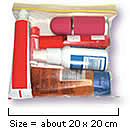 .3oz
capacity (approximately 100gm/3.5oz in weight).
.3oz
capacity (approximately 100gm/3.5oz in weight).