Australian
Natural Adventures
Wildlife,
Nature & Soft Adventure Tours
Custom
Australia, New Zealand & Pacific tours and travel

LOCAL
CUSTOMS
Australian
and New Zealanders are a casual, friendly lot, and tend to treat each
other equals. They’re happy to chat, and lend a hand. They tend
not to blow their own horn too much, so most introductions will be
first and last name – often a nickname – rather than Dr
this or Secretary that. Shaking hands – male and female –
is more usual than hugs or kisses. Although usually pretty straightforward
and direct, matters of politics, religion and salary or position are
generally not talked about, or the value of one’s house, car,
or other possession. Such talk leads to comments such as “he’s
got tickets on himself” –not a good thing. Australian
and New Zealand English is a bit more like English English, but with
plenty of American influence. It’s not a bad idea to try to
pick up the difference in accents between the two countries –
neither takes well being called the other! Some words have different
meanings, or emphases. You’ll pick this up as you go along –
and you won’t cause embarrassment, although you may cause a
bit of laughter. A lot of TV in Aus/NZ is from the US, so there’s
familiarity with American English, news, etc. Generally, humor Down
Under is more English, with a bigger emphasis on word humor and less
on physical humor – although every loves someone making a physical
fool of himself. The humor is pretty dry (sometimes you won’t
even know there was a joke), and often self-effacing – and that
may cut the other way as well, so don’t take offense. Teasing
is a national sport, so don’t take things personally, or at
face value. Often, the opposite of the attribute is the point of the
comment – so a comment such as “well, he always is a bit
quiet” probably means he’s the rowdiest of the bunch.
Paying your way is important Down Under. While picking up the tab
is often an act of braggadocio in the US, a failure to at least try
to do so may be seen as bludging (rhymes with fudging) – mooching
– in Australia. So the fight to see who pays in not about ego,
but about not being seen as a bludger. If someone buys you a drink
– “shouts” you – then it’s your turn
next. It’s considered bad form to leave a bar with a round –
everyone in the party buying drinks – unfulfilled. This can
obviously lead to more drinking than you may intend, but it’s
also unfriendly to say you’ll get your own. The simplest way
out is to buy a round, but not one for yourself. That’s OK.
Or to make a point of saying that it’s your turn to start next
time – but only if there will be a next time.
It’s
also considered the right thing to do if you are invited to someone’s
home for dinner to bring a bottle of wine (not food). This goes for
picnics as well. If it’s an afternoon at their pool, or similar,
some beer, or wine, should be brought along. If you forget, don’t
offer to go out and get something later – you’ll be told
not to, but the damage will be done. It is OK to drop in, deposit
some of your party, then immediately go back out to get something
making it clear that that was the plan all along.
DINING
See
above for in-home dining. There are two main sorts of restaurants
in Australia and New Zealand – licensed and BYO. At licensed
restaurants you buy the drinks from the restaurant. At BYOs you Bring
Your Own, and there’s a corkage fee which covers glasses etc.
You pour it yourself. The majority of average cafes and restaurants
are BYO. You cannot BYO to a licensed restaurant. Even restaurants
located within in a hotel – which is where most of the bars
are – can be BYO; you just nip into their take-away (take-out)
bottle shop to purchase something to drink.
Although
meat and three is still the staple for most Aussies and Kiwis, restaurants
tend towards a cosmopolitan cuisine, with a significant Asian influence.
It’s not uncommon to see a Greek dish with an Asian touch, or
a purely Indonesian dish mixed with otherwise standard offerings.
Seafood is especially prominent, with Australia utilizing tropical
fish and crabs, and New Zealand its bounty of shellfish and coldwater
fish. Serving sizes are generally aimed at feeding, not fattening
,you.
There
isn’t the rush to eat in A/NZ as there is here – eating
out is more of an event than a routine part of the week’s meals.
So expect to dine later – 8pm is common – and to take
longer; 2 or 3 hours is usual. Most restaurants take and expect bookings
– a line of people waiting for a table is rare, as restaurants
only allow for one or two covers per session. If a table is booked
for 8pm, the restaurant will not sell it to diners at 7pm, or even
6.30. In many restaurants there is no hostess station and you seat
yourself. Servers will not hover over you, and won’t tell you
their name and personal history. Once seated, it’s common to
have a pre-dinner drink – this is done at the table,
not at a bar. When you are ready to order, signal (politely) to a
server. The same goes when you need anything additional, and when
you are ready for the bill (check). You’ll often take this to
a cash register at the front for payment. Tables will get one bill;
it’s up to you to sort out who pays for what, not the restaurant
or the server. Water, let alone iced water, has to be requested, usually
each time. Soft drinks are single serve, no endless refills, as is
coffee (although at US tourist oriented hotels breakfast coffee may
be unlimited, but if you have to order another cup, you’ll probably
pay again.). Southerners especially beware, if you order tea, you’ll
get it hot, in a cup. Iced tea (let alone sweet tea) is a specialty
drink found at summer cafes.
DRIVING
Traffic
drives on the left! This is important not only if you are driving,
but when you walk across roads. You must look to the RIGHT first –
not the left. Never just step off a curb – think first. Pedestrians
have absolute right of way, even when not on a crosswalk, and also
have right of way at intersections – so when driving watch out
for them on your entry street before turning. Streets can be legally
crossed as long as you are more than 20 meters from an intersection
or pedestrian crossing. Pedestrian must obey pedestrian crossing and
normal intersection traffic lights. If there is a tram stop or safety
zone in the middle of the street and the lights start to flash or
change, you must remain in that area until the light go green again.
To
keep yourself correctly oriented when driving frequently look out
and down from the driver’s window – you should see the
road’s dividing line. (If the passenger can see it, you’re
in trouble!) Concentrate at turns – coming out of a turn, especially
from a divided road onto a two-way, is where most accidents happen,
and unless you are concentrating you may naturally swing to the wrong
side. And speaking of turns, there is no left (right in the US) turn
on red. Wait until the light turns green. Also different is that the
vehicle turning right has right of way, not the vehicle turning left;
ie, the vehicle in the intersection, not the one by the curb. When
turning right it correct to pull into the intersection, including
at lights as soon as they turn green, then turn when there is no on-coming
traffic, or once the traffic light turns orange or red. Naturally,
watch out for light runners, but this is not as prevalent over there
as in the US. Traffic rules state you should stay on the left lane
on a multi-lane highway unless you're overtaking, even if you are
doing the speed limit. Other drivers will usually make you aware of
this if you forget. If you have reason to be going slowly on two-lane
road, and traffic is backing up behind you, it is normal courtesy
to pull over and let them pass, then continue on your way.
Road
signs are literal – no stopping means just that; no standing
means you can stop only to let a passenger on and off, and no parking
means the driver has to be in the car with the motor running, and
ready to move on immediately if necessary. Loading Zones are for commercial
vehicles, not passenger vehicles, however if you’re just dropping
off a passenger, or it’s quiet and you can move off immediately
a commercial vehicle needs the place – wave to let the driver
know – then you’re usually OK. Not so if a parking or
police officer is there, though. Bus and taxi zones are similar, but
be very quick to move, before the taxi or bus starts to pull in. Look
at the road center striping; you cannot park opposite double lines,
or broken lines if the unbroken side is towards you. Your parked car
must be in the same direction as the traffic. And on the subject of
double lines, they cannot be crossed for any purpose, including turning
into driveways etc. Just allowing any part of your vehicle on, not
even over, a double line is an offence.
Speed
limits are strictly enforced – you can and will be ticketed
for exceeding the limit by as little as one or two kph. Generally
the limit on open roads is 100kph (62mph) – this includes two
and even one lane country roads - and in built-up areas 50kph, sometimes
60. Speed limits are usually well posted. The police do not care if
your speedo actually is reading low, and can prove it; you’ll
still be ticketed. Similarly with double lines – your wheels
cannot touch them, nor can you cross them for any reason, even to
turn into a driveway. The alcohol limit while driving is 0.05, and
police regularly set up road blocks and test every driver regardless
of driving behavior. Talking on a cell phone while driving is illegal
– thank you Aussie & Kiwi common sense.
Stop
signs mean a full stop, not a “rolling stop.” “Give
Way” means “Yield.” You cannot do a U-Turn at an
intersection with traffic lights unless it
signed “U-Turn Permitted.” At uncontrolled intersections
traffic on the right has right of way, regardless of order of arrival.
Through traffic has right of way at T intersections. Seat belts are
compulsory for drivers and passengers.
Roundabouts
may be a bit confusing at first, but are designed to keep traffic
flowing – do not stop unless there is a car on your right to
give way to and try to just slow so you merge rather than stop and
start; it is not necessary to stop if it is two-lane roundabout and
the other vehicle is in the inner lane (of course you must only drive
into the outer lane). In two lane roundabouts you use the outer lane
if you are going to turn left or go straight ahead, the inner lane
for turning right or going straight ahead. You must signal your intent
to exit the roundabout, either left or right.
The
hardest trick is the infamous Melbourne hook turn. This occurs where
both streets at an 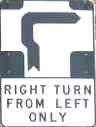 intersection
have tramlines, and a vehicle must not wait on a tramline to complete
a turn – remember this whenever driving in Melbourne; their
35 tons of steel and iron have right of way at all times. All the
relevant intersections are posted, as per the illustration. The procedure
is to pull into the intersection in the left lane, with your right
turn indicator on. Thr ugh traffic will pass on your right. Once the
lights turn, swing to the right across the intersection into your
new street. It’s easier than most people make out; it’s
just a standard right turn made from the leftmost lane after the lights
turn and traffic has cleared. As you cannot block trams, turning right
on a street with tram track means waiting in the lane to the left
of the tracks, not on the tracks. Make sure you allow room for the
body of the tram, by the way. Your turn may block traffic, but oh
well.
intersection
have tramlines, and a vehicle must not wait on a tramline to complete
a turn – remember this whenever driving in Melbourne; their
35 tons of steel and iron have right of way at all times. All the
relevant intersections are posted, as per the illustration. The procedure
is to pull into the intersection in the left lane, with your right
turn indicator on. Thr ugh traffic will pass on your right. Once the
lights turn, swing to the right across the intersection into your
new street. It’s easier than most people make out; it’s
just a standard right turn made from the leftmost lane after the lights
turn and traffic has cleared. As you cannot block trams, turning right
on a street with tram track means waiting in the lane to the left
of the tracks, not on the tracks. Make sure you allow room for the
body of the tram, by the way. Your turn may block traffic, but oh
well.
Multi-lane
highways are not as common as in the US, and as the maximum speed
limit is usually100kph, allow 80kph as the average speed achieved
for distance travel.
If
you are driving in the country at night, especially up north, out
west, in Tasmania or on Kangaroo Island be very watchful for kangaroos
and wallabies; like deer they will suddenly enter the roadway with
no forewarning. There’s a reason for all those steel contraptions
on the front of country trucks and cars. It is best to avoid driving
at night in these areas if at all possible.
If
you have the misfortune to be driving “The Track” –
the Stuart Highway in the Northern Territory, or anywhere where road
trains operate, do be aware that they can take a half a mile to stop,
and will not risk jack-knifing their “dogs” – trailers
– by pulling half off the road. Give them wide berth at all
times, including pulling completely off one-lane roads to let them
pass – they can’t drop their wheels onto the shoulder
as can cars. Many outback and some country roads are one or one and
a half lane, and require you to drive half on the road and half on
the shoulder (if there is one, otherwise drive on whatever’s
there) when passing another car. Slow down if there is gravel or stones
along the side, as they can fly up and break windscreens, surprisingly
even your own.
Lastly,
don’t be too embarrassed when you turn on the wipers instead
of the turn indicator – every tourist does it. Often. Most importantly,
remember the Golden Rule: yield – give way in Australian/NZ
lingo – to the right. But also don’t forget the Iron Rule
– old and big iron gets right of way over new and small iron.
SAFETY
Sharks,
snakes and spiders. Yes, they all are there, some are extremely deadly,
and generally they are common. But most get well out of your way before
you know they are there – Australia doesn’t have the equivalent
of rattlesnakes that just lay there – and New Zealand has only
a couple of poisonous spiders and no snakes. Most visitors see none
of above, even when trying to. Sunburn is a far greater threat on
the beach, or maybe a sore neck pretending not to look around –
most beaches have no restrictions against topless sunbathing or swimming,
and then there’s those little speedos all the lifesavers and
others wear…..
The
northern one third or so of Australia suffers from the presence of
deadly jellyfish along the coast from about December to March, and
under no circumstances swim in the sea at this time – death
can be swift, and the stings are unbelievably painful. You can swim
out on the Great Barrier Reef at this time, however. Many northern
beaches have special mesh enclosures safe for swimming. Many beaches,
especially surf beaches, are patrolled by volunteer life savers on
weekends and during holidays. There’ll be a pair of yellow and
red flags; always swim between these, as there could be unsafe water
a little way outside them. The lifesavers keep tabs on rough conditions,
and close beaches accordingly; more popular areas are scanned for
sharks both from lookout towers and by airplane. You can tell if one
is seen by the mass migration of swimmers from the water. If you see
this, don’t just wonder what’s happening – get out
of the water. If you are on a patrolled beach, and you get into difficulties,
raise your arm above your head – this should attract the watchers
attention.
Waving will mostly be thought to be just that – waving. Most
Australian beaches are surf beaches, with waves and currents. Generally
the sort of conditions that would close any US east coast beach is
considered just a normal shore break in Australia. The waves on all
coasts roll in with no interruption for thousands of miles, and often
develop considerable power. Be aware that you’ll get tired more
quickly, due to the continual jostling of the rougher water. Keep
an eye on a landmark on shore, to avoid finding yourself further out,
or further along the beach than you thought.
All
food and water in Australia/NZ is safe to consume (even Vegemite!)
Most casual restaurants are seat yourself, and even at bars with tables
you usually buy your drinks at the bar, rather than wait for a waitress
at your table. Australia and New Zealand both have many fine restaurants,
innovative cuisines, plenty of fresh fruit (including many you will
not be familiar with) and some of the world’s best wines to
wash it down. Make sure you try something different while you are
there.
Both
Australia and New Zealand are low-crime countries, but as always,
wealth flaunting and inappropriate behavior can lead to trouble. Lock
your car, and don’t leave valuables lying about. But as you’ll
see once there, most local people take no particular precautions when
out and about.
CALLING
HOME
Australia
has an excellent and simple phone system. The cheapest (usually) and
easiest way to call home is to purchase a phone card, available everywhere,
and use public phones. There are two kinds, one primarily for local
calls, with which you just dial the number, and the kind familiar
to users here, best used for international calls. Unless you have
a special model, and an appropriate international plan, your cell
phone won’t work overseas; even with such a plan the calls will
be far more expensive, and incoming calls will cost considerably more
for the caller than their normal international rate. If you must have
a cell phone you can rent one there (or even buy one second-hand),
and buy minutes as required. Internet cafes are widespread, so for
a few dollars you can log on to check and send emails. If you have
a proprietary ISP such as AOL or Compuserve you can use their “.com”
site to access and send your messages. Setting up a Yahoo account
will give you more facilities, such as message storage. But remember,
being on vacation means just that – you’ll enjoy your
stay more by saying to your friends and family “talk to you
when we return.”
MEDICAL
MATTERS
No
immunizations are required for Australia or New Zealand, unless you
have been to a Yellow Fever country – South America or Africa
– in the previous six days, when a Yellow Fever Certificate
is required. We highly recommend that your tetanus shot is up to date
– though no more prevalent down there than here, tetanus can
stop a vacation in its tracks. There’s no rabies in either country.
Both
Australia and New Zealand have excellent medical facilities, and doctors,
hospitals and medicines are cheaper than in the US. Many US insurance
plans do not cover or restrict services overseas – please check
with yours. We highly recommend travel insurance; although excellent
care is available locally, associated transport costs, especially
from remote areas can be high, and aren’t usually covered by
your own insurance. Australian Natural Adventures can assist you in
obtaining travel insurance from a reputable third-party insurer. US
prescriptions cannot be filled in Australia or New Zealand. If you
wish to replenish your supply while overseas you will need to visit
an in-country doctor for a local prescription. Such visits are inexpensive.
We recommend taking a copy of your current prescription(s) with you
to ensure an exact replacement. Please note that some specialized
drugs may not be available overseas.
If
you are scratched by coral on the Great Barrier Reef, no matter how
minor, have the boat crew attend to it – coral contains particularly
nasty bacteria which can cause rapid infection.
The
greatest medical risk in Australia is sunburn; the sunny climate and
clear skies help Australians have the highest rate of skin cancer
in the world. Even in cloudy weather burning is possible; for fair-skinned
people skin damage can occur in as little as 20 minutes in summer.
Cover up with a hat and sunscreen.
RANDOM
THOUGHTS AND TIPS
To help recover
lost cameras or memory cards photograph your name and address and
leave the image on each memory card. Taking a photo of your hotel
name when you arrive may also help quickly return a lost camera, or
just photograph your hotel list. Although large capacity memory cards
can hold all your photos, they do get corrupted, and we recommend
using several smaller cards rather than one large one. Downloading
photos via the internet from time to time can also prevent loss of
those precious memories. Don’t wait until you arrive to learn
about your new camera – saving $50 at the duty-free store or
on a last-minute web bargain isn’t a deal if you lose the memories
of a $5000 once-in-a-lifetime trip.
As you enter each town or area take a photo of the
town’s name, as the first shot and when you depart. Six months
later you’ll be able to tell where you took the shot and work
out general scenery in between. This also works for hotels, attractions,
etc.
Ziplock bags are the duct tape of travel; always carry
a few of various sizes. In flight they can be used to enclose tubes
that might leak due to pressure changes, including ballpoint pens.
Large sizes can hold wet swimsuits, useful if you want to be in the
water on the day of your return. They’re also good for smelly
or just dirty socks. Also take a few plastic grocery bags for larger
dirty items, such as shoes. A little laundry detergent in a ziplock
will also be useful along the way. On the beach or in a boat a ziplock
is useful for carrying your camera to avoid sand and salt spray; securely
fastened it will keep water out for long enough if your camera (or
phone) is briefly dropped in water.
While a poncho or other wet gear should be part of
your luggage, a decent travel umbrella is very useful in the tropics
especially, as the rain is often of short duration and comes straight
down. Umbrellas roll back up into their sheath, and can be placed
in a grocery bag when wet, whereas bulkier wet weather gear is harder
to keep separate from dry clothes, and is often makes you pretty steamy
while wearing it.
If you plan
to buy clothing locally, save space on your return by taking old clothes
that you no longer wear, wear them until you replace them during your
stay with local goods, then leave them in Australia, preferably with
locals who will use and appreciate them. This way your bag will be
no fuller on the return then when you departed the US.
Save space by putting non-prescription pills in one
container, but don’t forget to include a guide – colors,
eg – as to what each one is. Prescription pills are best left
in their own container, or if you buy them in bulk transfer to a small
one but make sure you take your prescription with you to avoid problems
at borders.
If you a birder, and taking a guide, here’s
a suggestion to make IDs easier. Go through the book, and work out
which birds occur in the area you’ll be visiting, and maybe
the altitudes. Use colored dots from the office supply store to mark
the plates of the possibilities. We use codes such as blue for lowland
only, green for above 1000m only, etc; dots can be overlapped for
wider ranges. An “R” for “very rare” can be
written on the dot to further refine things. When you have to quickly
look at a page of unfamiliar and confusingly similar birds, the possibilities
will stand out from the rest. It’s quicker, and more concise
than making written notes. This also works for general destination
guidebooks so when you are in a city you can quickly see the must-sees
and must-dos.