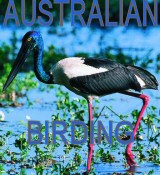
Australian
Natural Adventures
Birding
in Australia
Custom
Australia, New Zealand & Pacific tours and travel

17-Day
Birding & Wildlife Tour
AUSTRALIA

Day
1 - Los Angeles / Lost in Space
Check in at the Tom
Bradley International Terminal at Los
Angeles Airport for our Qantas flight to Sydney, Australia. Australia
begins the moment you step aboard your Qantas
flight. The Australian style is apparent—easy going, casually
efficient and very friendly. Qantas is known for its excellent food
and in flight service, so sit back and enjoy the hospitality, meal
and a movie. *D
Day
2 – Lost in Space
Day lost due to the International Dateline, but regained on the return
journey.
Day
3 – Sydney / Cairns
Arrive in Sydney (or Brisbane), Australia early this morning. Pass
through customs and immigration and transfer via the terminal bus
to the domestic terminal for the flight to Cairns, far North Queensland.
On arrival in Cairns we are met and transferred to your waterfront
hotel, the Tradewinds
Esplanade. The hotel is located on Cairns
Esplanade, and directly opposite the best shorebird viewing site.
At any time of the day the exposed muddy areas are prime feeding for
hundreds of shorebirds, from large pelicans to tiny, busy Terek Sandpipers.
Greater and Lesser Monglian Plovers, two species of tattler and of
godwit, Marsh and Broad-billed Sandpiper, are some of the regulars,
plus terns and a variety of herons. Low tide is mid-afternoon today,
and although not the best for shorebirding, it is a medium tide and
therefore not too far out. Although there are no structured activities
today, there will be a birding guide on the Esplanade to help with
shorebird ID. After our lunchtime arrival the rest of the day is free
to relax. Don't, however, be tempted to have a nap or even lie down
- we need to stay awake until at least 8pm to sleep well enough tonight
to fall into the local time zone. As well as the hotel restaurants
there are many others nearby.
*M,*B
Day
4 – Great Barrier Reef
Today you are introduced to one of the natural wonders of the world—Australia’s
Great Barrier Reef, a series of reefs extending for about 1,250 miles
along the coast of Queensland, nearly to Papua New Guinea. On your
trip today you experience two important features—a coral inner-shelf
reef, and the sandy vegetated cay formed on one end. Michaelmas Reef
lies about 22 miles off the coast just north of Cairns, with Michaelmas
Cay on its southern tip. It is an important seabird rookery, which
becomes apparent as you approach the mass of birds swirling constantly
above the cay. The four primary species are Crested, Lesser-crested
and Sooty Terns, and Common Noddy. Lesser Frigatebirds are usually
present, occasionally Greater, as are Silver Gulls, Brown Boobies
and Ruddy Turnstones. The cay, most of which is off limits, is a National
Park within the Great Barrier Reef Marine Park. However, the birds
are very tolerant of visitors and stand thickly along the beach, allowing
us to approach them within a few yards and less. Immediately offshore
in waist-deep water, the first of the corals can be seen. For those
not used to snorkeling, there is no easier introduction—just
walk up to your waist, and bend over. Brilliantly
colored fish, giant clams, beche de mer and coral outcrops can
all be seen. Easy swimming in shallow water brings us over coral “bombies,”
heads of coral with their assortment of fishes, and hard and soft
corals. Parrot fish glean algae from the coral, and small and medium
predators search for food. Schools of fish twist and flash between
the outcrops. An occasional sea turtle may be seen. You glide around
the coral in a semi-submersible submarine, dry and with your ordinary
cameras, while a marine biologist describes the species seen and some
of the processes at work. If you are interested, there are guided
snorkel tours led by a marine biologist at additional cost. On your
trip out, one of the marine biologists explains the development of
this and other reef systems and gives us an introduction to many of
the animal species that you see. Lunch is a tropical smorgasbord.
In the afternoon you return to Cairns, under sail if the winds are
right. Your transport to the reef is a 105
foot luxury, motor-sailing catamaran. There is time after your
return this evening to visit Cairns, or you may wish to relax poolside
at the hotel. L
Day
5 – Cairns / Atherton Tablelands
Early this morning we are picked up to begin birding and looking for
other wildlife of the rainforest of the Atherton Tablelands. These
World Heritage listed rainforests, at an elevation of about 2,500
ft, are home to some of Australia’s rarest and most unusual
animals, including four kinds of very restricted possums, gliders,
and the definitely weird tree kangaroo, a kangaroo which has adapted
to a life in the trees, rather than on the ground. Your guide will
take you to a small stream to wait for platypus, the egg-laying mammal
unique to Australia, all the time describing the plants and dynamics
of the surrounding rainforest. The endemic birds of the region are
high on the target list. A special trip is made to a bower of the
beautiful Golden Bowerbird, and in this area Satin Bowerbirds should
also be seen. Mountain Thornbill, Atherton Scrubwren, Bridled Honeyeater,
Bower's Shrike-thrush, the northern race of Lewin's Honeyeater and
Fernwren are restricted to these higher areas. Spotted Catbird, Pale
Yellow-robin, Rufous Shrike-thrush, Scrub Turkey, Grey-headed Robin,
and Large-billed Scrubwren are more altitudinally widespread. Sunset
will find us at a small swamp waiting for the evening arrival of Brolgas
and Sarus Cranes. After dinner other animals, perhaps including the
leaf-tailed gecko - eight inches long and colored and shaped like
a piece of bark - will be found and seen, as we spend a couple of
hours spotlighting for nocturnal animals, and owls including Barn
Owl and Lesser Sooty Owl - Rufous Owl is possible - always make this
a highlight of the day. D
Note:
a full bird & wildlife trip list can be found here
Day
6 - Inland / Daintree
 This morning after an early birdwalk we head north, out of the rainforest
to drier country on the inland side of the Great Dividing Range. Along
the way we'll stop at a small gorge to look for Mareeba Rock Wallabies,
Pale-headed Rosella, Great Bowerbird, probable Red-winged Parrot,
lorikeets, and other dry-country birds. These continue to be our focus,
as we visit wetlands at Mareeba for a variety of ducks and Black-necked
stork. Our exact itinerary will depend on bird activity, but we'll
end the day back on the coast near Daintree, for our early morning
river trip tomorrow.
This morning after an early birdwalk we head north, out of the rainforest
to drier country on the inland side of the Great Dividing Range. Along
the way we'll stop at a small gorge to look for Mareeba Rock Wallabies,
Pale-headed Rosella, Great Bowerbird, probable Red-winged Parrot,
lorikeets, and other dry-country birds. These continue to be our focus,
as we visit wetlands at Mareeba for a variety of ducks and Black-necked
stork. Our exact itinerary will depend on bird activity, but we'll
end the day back on the coast near Daintree, for our early morning
river trip tomorrow.
Day
7 - Daintree / Cairns
 We
start the morning with a birding river trip with
We
start the morning with a birding river trip with Chris Dahlberg, aimed at finding species such as Shining Flycatcher,
Little Kingfisher, Papuan Frogmouth and Great-billed Heron. An average
of 50 species is seen, including non-birds such as Saltwater Crocodile
and Spectacled Flying-fox. We then continue to bird lowland rainforest,
estuary and open woodland for target species, ending the day back
in Cairns. Our three-day effort should yield 100 - 200 species, and
includes a variety of habitats including dune, mangrove, estuarine,
open scrub and forest, swamp, river and lake, and lowland and upland
rainforest.
Chris Dahlberg, aimed at finding species such as Shining Flycatcher,
Little Kingfisher, Papuan Frogmouth and Great-billed Heron. An average
of 50 species is seen, including non-birds such as Saltwater Crocodile
and Spectacled Flying-fox. We then continue to bird lowland rainforest,
estuary and open woodland for target species, ending the day back
in Cairns. Our three-day effort should yield 100 - 200 species, and
includes a variety of habitats including dune, mangrove, estuarine,
open scrub and forest, swamp, river and lake, and lowland and upland
rainforest.
continue
your Australia itinerary >>>